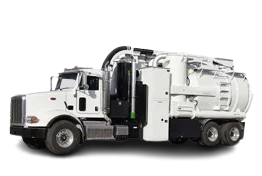
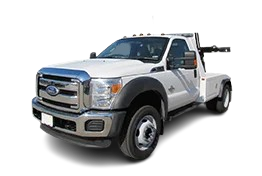
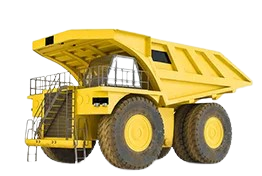
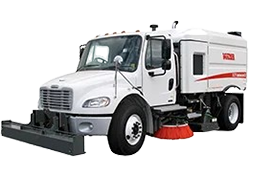


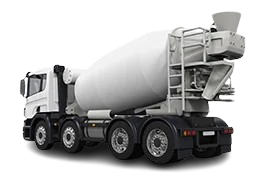
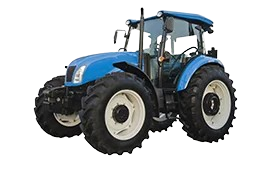
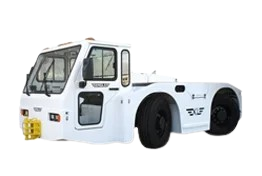
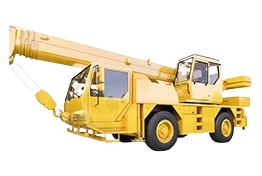
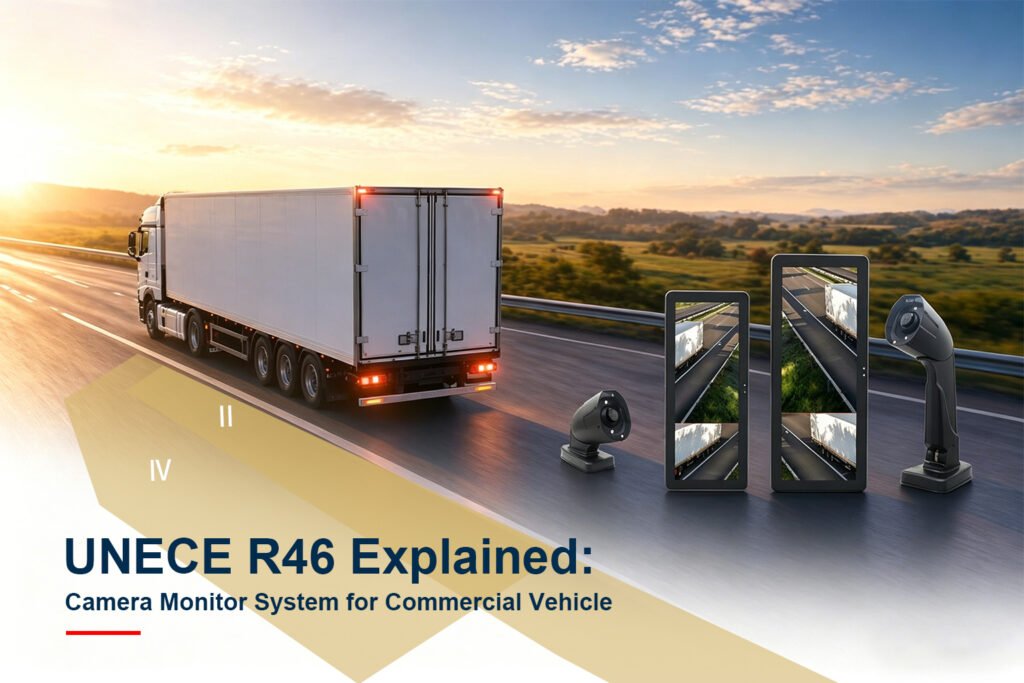
Commercial vehicles have relied on exterior mirrors for indirect vision for decades, but mirror coverage is constrained by vehicle geometry and fixed mounting points. For fleets and OEM teams evaluating a camera monitor system (CMS) as a mirror replacement, UNECE Regulation No. 46 (UN ECE R46) is a core reference because it defines type-approval requirements for devices for indirect vision.
In everyday operations, the most persistent visibility challenges are typically concentrated near the A-pillar, along long trailer sides, around rear corners during turns, and close to the wheels during low-speed maneuvers. In rain, glare, and crowded yards, the issue is often not whether an object is visible, but whether the driver can interpret position and closing distance fast enough to act.
UNECE R46 addresses this by specifying required fields of vision (by device class) and the approval logic for mirrors and equivalent alternatives, including when camera monitor systems may be used. In practice, R46 approval is not a “check-the-box” exercise: it is a type-approval process that requires documented evidence, prescribed testing, and correct vehicle installation to demonstrate that the system meets the regulation’s requirements for coverage, image-related performance, system delay, durability, and installation.
What is UNECE R46 for Indirect Vision Devices?
UNECE R46 is a regulation issued by the United Nations Economic Commission for Europe (UNECE). It is a type-approval framework that standardizes requirements for devices for indirect vision on vehicles.
In practical engineering terms, R46 defines:
- Required viewing areas through device classes (often discussed using mirror class terminology such as II, IV, V, VI)
- Required fields of vision on both sides of the vehicle for the applicable classes
- Performance expectations that support driver interpretation of the view (including aspects related to clarity and distortion control)
- Day/night behavior, including brightness and contrast handling
- Limits on system latency so the displayed view remains timely
- Environmental robustness expectations (e.g., vibration, temperature, water, dust)
- Installation-related considerations, including camera placement and monitor positioning in the cab
For the official consolidated text, see UNECE: UN Regulation No. 46 Revision 7 consolidated text *.
In the EU, indirect vision also sits within broader vehicle safety legislation. Two common references used in compliance work are Regulation (EU) 2019/2144 General Safety Regulation * and Commission Regulation (EU) No 581/2010 on indirect vision devices *.
Why Mirrors Struggle in Real Operations?
Mirrors can be compliant on paper and still feel inadequate in day-to-day driving. The gap comes from both geometry and human factors.
-
Near-field coverage is geometry-limited. Zones close to the vehicle side can be difficult to cover without introducing trade-offs in other viewing areas.
-
Driver workload increases. Drivers often compensate by leaning or re-checking angles, which adds cognitive load during turning and low-speed maneuvers.
-
Higher exposure to damage. Protruding mirror assemblies are vulnerable in depots, loading bays, and narrow streets.
-
Reduced interpretability in adverse conditions. Rain, spray, fog, and night glare can reduce contrast and make the reflected view harder to interpret.
-
Articulated configurations extend side-zone risk. Long vehicles and trailers can create extended side areas that are difficult to monitor consistently with conventional mirrors.
This is why many OEMs and fleets are moving toward R46-compliant camera monitor systems—not because cameras are “automatically safer,” but because performance can be designed, tested, and validated.
How Camera Monitor Systems Support Indirect Vision?
A camera monitor system is not automatically safer. Its practical value is that indirect vision becomes something you can design, verify, and maintain.
In engineering and fleet evaluations, the focus is usually on three outcomes:
-
Coverage of the required zones on the actual vehicle configuration
-
Image interpretability in conditions where mirrors often degrade (spray, low light, glare)
-
Packaging and damage exposure considerations compared with large mirror assemblies
Applicable Vehicles and Scenarios
Indirect-vision performance is most demanding when vehicle geometry is large, operating space is tight, and the surrounding environment changes quickly. These conditions increase the frequency of close-proximity interactions and reduce the margin for driver interpretation errors.
This is why UNECE R46-related indirect-vision decisions are most relevant for:
-
Urban delivery trucks and tractors, where curbside exposure, cyclists, and frequent turns create persistent side-zone conflicts
-
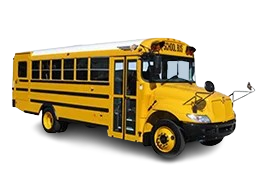
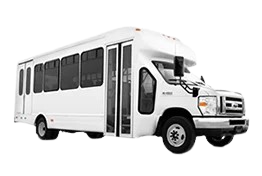
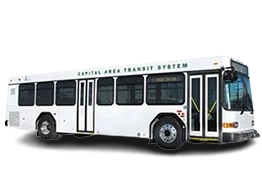
Buses and coaches, where passenger-side sweep zones and high pedestrian density require consistent indirect vision in stop-and-go traffic
-
Yard, terminal, and dock maneuvers, where repeated low-speed movements, blind corners, and mixed traffic make mirror-only setups harder to manage
-
Night and all-weather operation, where rain spray, low illumination, and glare can reduce image interpretability and slow decision-making
AOTOP UN ECE R46 Camera Monitor System(CMS)
We have obtained UNECE R46 certification for our camera monitoring system solutions for trucks, buses, and special vehicles. This means the system is designed to meet the regulation’s requirements for indirect vision devices, supporting mirror replacement programs where compliant coverage and driver-facing usability are mandatory.
On our R46 page, we describe the solution as a UN ECE R46 digital mirror camera system and list certifications including “R46 Certified” and “R10 Certified.” In practical deployments, the architecture replaces conventional mirrors with streamlined exterior cameras and in-cab displays, helping maintain indirect vision in challenging commercial-vehicle conditions such as rain spray, glare, and low illumination.
For the referenced configurations and specifications, see AOTOP’s UN ECE R46 page.
Closing Note
UNECE R46 is widely referenced because it provides a consistent type-approval framework for indirect vision on commercial vehicles, including the conditions under which camera monitor systems may replace conventional mirrors.
For projects involving a camera monitor system or digital mirror system, this regulatory clarity helps keep product definition and market access requirements aligned across markets that apply UNECE standards.