























































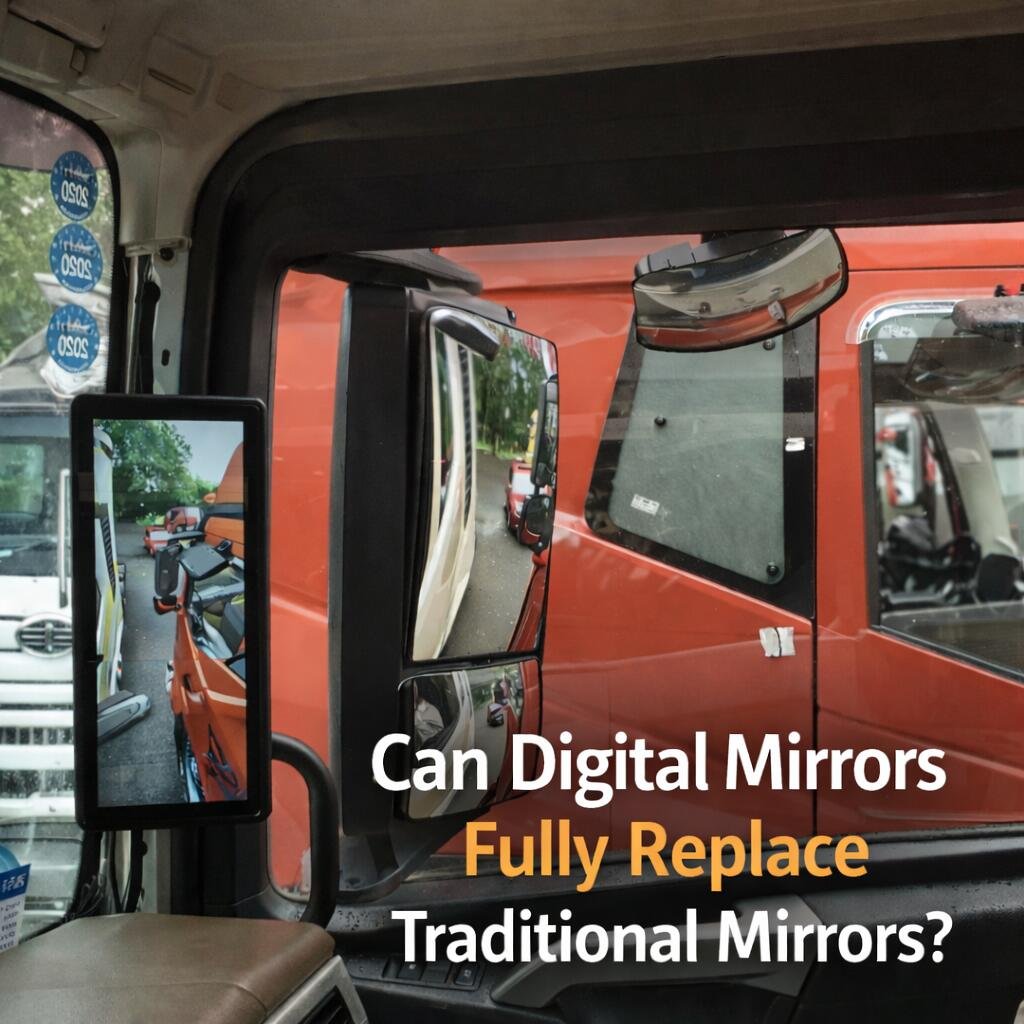
In commercial vehicle operations, visibility is not a convenience feature — it directly affects accident exposure, liability risk and insurance cost. With the growing adoption of Digital Mirror Systems (also known as Camera Monitor Systems, CMS), fleet operators are increasingly considering whether these systems can fully replace traditional mirrors.
The short answer: Technically yes in certain markets — operationally, it depends on regulatory compliance, environment and fleet-specific needs.
1. Regulatory Perspective: Are Digital Mirrors Legally Accepted?
* Europe
Under UN ECE Regulation No. 46 certified camera monitor systems are legally allowed as alternatives to conventional mirrors in vehicles registered in the EU and other ECE member countries. This shift reflects the need to address safety concerns around blind zones in large vehicles, especially in urban environments.
This regulatory evolution aligns with accident data from the European Commission showing:
- Heavy goods vehicles are involved in a disproportionate share of fatal cyclist collisions in urban areas.
- Right-turn blind-spot conflicts account for a significant percentage of truck–cyclist fatalities in major EU cities.
- Urban vulnerable road users (pedestrians and cyclists) represent a large share of road fatalities in dense delivery environments.
To mitigate blind-zone risks, the EU further introduced:
- UN ECE Regulation No. 151 (Blind Spot Information Systems for heavy vehicles)
- UN ECE Regulation No. 159 (Moving-Off Information Systems)
* United States
In the U.S., the U.S. Department of Transportation and the National Highway Traffic Safety Administration (NHTSA) regulate mirror requirements under the FMVSS (Federal Motor Vehicle Safety Standards). While traditional mirrors remain the standard, CMS technology is under active evaluation.
NHTSA crash data shows:
- Hundreds of fatalities annually are linked to backover incidents.
- Thousands of injuries occur each year during low-speed maneuvers.
Large vehicles are disproportionately involved in crashes due to blind spots, especially in urban settings.
The U.S. regulatory framework is more conservative than Europe’s, but accident data continues to show the need for enhanced visibility systems, suggesting the potential for future regulatory revisions.
2. Why Accident Data Is Driving the Shift Toward Digital Mirrors?
A. Blind Spot Geometry and Urban Conflict Zones
Traditional mirror systems — even multi-panel configurations — leave:
- Passenger-side close-proximity blind areas
- Front-right corner blind zones
- Trailer articulation blind spots
- Occlusions from cargo body design
These zones directly overlap with high-risk accident scenarios:
- Cyclists traveling parallel to delivery vans
- Pedestrians positioned near right-front corners
- Workers near loading docks
Digital mirror systems expand field of view beyond the geometric limits of reflective glass. Wide angle external cameras provide continuous monitoring of near-field zones that are structurally difficult to cover using traditional mirror placement.
For urban delivery fleets, this is not theoretical improvement — it addresses statistically documented blind-zone exposure.
B. Night and Low-Light Conditions
A substantial proportion of pedestrian fatalities in both Europe and the U.S. occur in low-light conditions. Traditional mirrors are limited by ambient lighting and headlamp reflection.
Digital mirrors, however, integrate:
- HDR image processing
- Low-light enhancement
- Infrared-assisted visibility
This improves visibility during early morning routes, nighttime driving, and in adverse weather conditions. These systems provide more stable and consistent visibility compared to traditional mirrors, which can be limited in such conditions.
C. Aerodynamic and Operational Efficiency
Protruding mirror housings increase aerodynamic drag, especially in long-haul applications.
European fleet operators report fuel efficiency gains typically in the low single-digit percentage range after switching to camera-based systems. While not the primary safety driver, high-mileage fleets may see measurable annual fuel savings.
3. Practical Constraints Before Full Replacement
Even where legally permitted, full replacement requires evaluation.
Driver Adaptation
Drivers accustomed to optical mirrors will need time to adjust to screen-based reference points, depth perception differences, and new display angles. Fleet training programs will be essential to ensure smooth transitions and minimize the risk of misjudgments during early adoption.
System Reliability
Unlike traditional mirrors, digital systems rely on power supply, display units, camera modules, and signal transmission. Commercial-grade systems must include redundancy and fail-safe strategies to ensure reliability in demanding operational environments.
Weather and Contamination
Camera lenses can be affected by dirt, snow, ice, or road spray. High-quality commercial systems typically include heating elements, hydrophobic coatings, and protective housings to address these issues. Without these features, the performance of digital mirrors can degrade faster than conventional mirror glass, particularly in harsh environments.
4. So — Can Digital Mirrors Fully Replace Traditional Mirrors?
In Europe:
Yes — when systems comply with UN ECE Regulation No. 46 and other relevant standards, digital mirrors are fully permitted as replacements for traditional mirrors.
In the United States:
The replacement of traditional mirrors with digital systems is still limited by current FMVSS standards, though ongoing evaluations suggest regulatory updates are on the horizon.
In Fleet Operations, many operators are taking a hybrid approach:
- CMS + physical mirror redundancy.
- CMS as the primary system, supplemented by additional blind-spot detection.
These choices are driven by operational safety, risk management, and insurance requirements rather than purely technological considerations.
Conclusion
Digital mirrors can fully replace traditional mirrors in markets where regulations such as UN ECE Regulation No. 46 permit certified camera monitor systems.
Crash data in both Europe and the United States shows that blind-zone visibility remains a primary factor in pedestrian, cyclist, and low-speed maneuvering accidents involving commercial vehicles. Digital mirror systems expand near-field and side coverage beyond the physical limits of reflective glass, directly addressing these documented risk areas.
Whether they should fully replace traditional mirrors depends on three practical factors: regulatory compliance, system reliability, and fleet operating conditions. When these requirements are met, digital mirrors are technically capable of serving as a complete visibility solution in commercial vehicles.