
Regular in-vehicle camera system are passive: they show a live view and the driver has to notice risk.
AI detection in vehicle camera systems makes the camera feed actionable. AI can recognize objects (such as pedestrians or vehicles), check whether they enter a defined “risk zone,” and trigger audible/visual warnings.
This shift from image display to risk recognition is why AI-enabled camera systems are becoming a serious safety tool for commercial fleets operating in dense cities, busy yards, and job sites.
What Does “AI Detection” Mean in a Vehicle Camera System?
AI detection means computer-vision software analyzes live video and answers questions like:
-
“Is there a person behind the vehicle right now?”
-
“Is a vehicle entering the side warning zone?”
-
“Is something moving closer than the safe distance we configured?”
From a safety perspective, this is the same idea behind many driver-assistance features: detection enables warnings (and in some systems, interventions).
A simple example: Ford describes its Pre-Collision Assist with Pedestrian Detection as using radar and camera technology to scan ahead and sound a warning when a potential collision with a vehicle or pedestrian is detected (Ford support: Pre-Collision Assist with Pedestrian Detection). The important takeaway for fleet buyers is also in OEM language: these systems assist the driver—they don’t eliminate responsibility.
Why AI Detection Matters for Commercial Fleets
Fleet safety and compliance leaders are usually optimizing for three things:
-
Lower incident risk in predictable scenarios (reversing, turning, tight yards).
-
More consistent hazard awareness (less dependence on perfect attention every second).
-
Operational acceptance (a system drivers can live with day after day).
AI detection matters because, when correctly installed and tuned, it can help reduce the time-to-notice in blind or busy zones—turning “something might be there” into “pay attention now.”
How AI Detection in Vehicle Camera Systems Works
Most deployments follow a straightforward workflow:
-
Capture — one or more cameras provide live video (rear/side/front/multi-camera).
-
Inference — an onboard processor runs detection models on each frame.
-
Zoning — detections are evaluated against configured warning zones.
-
Alerting — the cab monitor interface triggers visual overlays and/or audible warnings.
Mobileye, a major ADAS computer-vision provider, describes pedestrian detection as fundamentally about robust recognition from camera feeds using an array of algorithms and methods (Mobileye: Pedestrian Safety Month—Protection Begins with Detection). You don’t need to adopt their approach to learn the core lesson: reliability comes from engineering choices (hardware, tuning, redundancy), not from one “magic” model.
Common AI Detection Use Cases in Vehicle Camera Systems
Reverse Assist: Pedestrian Detection Warnings Behind the Vehicle
Backing is a high-frequency risk moment in yards and urban deliveries. An AI camera pedestrian detection warning workflow means the system recognizes human form and alerts when a person enters a rear warning zone.
AOTOP provides an example of this category in its AI lineup: 1080P AI reverse camera (human form recognition)—a practical reference point for AI reverse camera human detection scenarios.
Warning: If the lens is blocked by mud, snow, glare, or a poor mounting angle, the system can miss what it can’t see.
Blind-Spot Detection: Camera-Based Awareness on the Sides
“Blind spot detection camera AI” often refers to side-mounted detection with configurable zones—useful in right-turn and lane-change scenarios where large vehicles have unavoidable blind areas.
The operational goal isn’t to replace mirror checks; it’s to add a timely prompt when an object is in the danger zone.
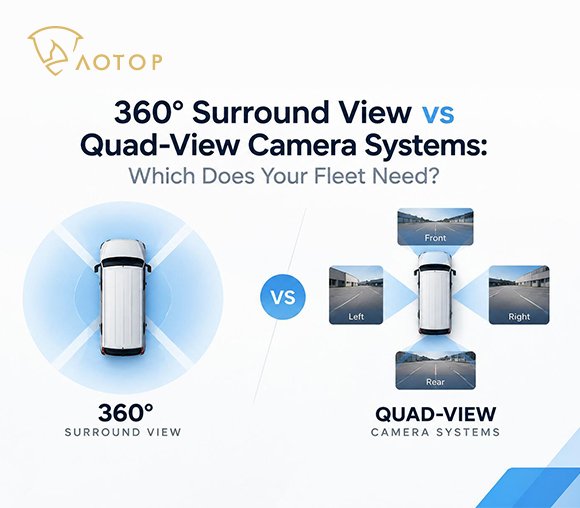
360° Surround View with AI Overlays
A 360° system stitches multiple cameras into a surround/top-down view. When combined with AI, it can highlight objects and zones more clearly during low-speed maneuvering—an AI 360 surround view for trucks style setup.
AOTOP’s example is its 3D surround view AI 360 vehicle camera system for trucks.
Low Light and Harsh Conditions
Visibility is the hard constraint for camera AI. In low-light or low-contrast environments, some fleets evaluate sensor approaches that can improve perception robustness.
One example category is dual-spectrum setups that include thermal/IR imaging. AOTOP’s lineup includes a dual-spectrum IR thermal imaging camera with AI for this type of scenario.
Real-World Limitations (and How to Manage Them)
AI detection creates value when it’s deployed with clear limits.
-
Weather, glare, and occlusion reduce accuracy. If the camera can’t see it, detection won’t happen.
-
False positives and alert fatigue are real. Too many warnings trains drivers to ignore warnings.
-
“Assistive” doesn’t mean “autonomous.” Keep the message consistent: alerts support the driver; they don’t take control.
Pro Tip: The fastest way to kill adoption is to treat alerts as a “gotcha.” Clear purpose (risk visibility), transparent data use, and sensible zone tuning go further than aggressive settings.
AOTOP and AI-driven in-vehicle monitoring
If you want to explore how AOTOP approaches AI-based in-vehicle monitoring, start with the AOTOP AI section and the A-series examples linked above.
At AOTOP, we are committed to advancing AI-driven technologies in the field of intelligent in-vehicle monitoring. By developing smart in-vehicle monitoring devices and exploring diverse application scenarios for automotive safe vision AI, we strive to bring safer, smarter driving experiences. Our goal is to enhance vehicle safety and accelerate the transformation toward intelligent mobility.
Frequently Asked Questions (FAQ)
Ⅰ.What is AI Detection in Vehicle Camera Systems?
AI detection in vehicle camera systems is the use of computer-vision algorithms to recognize objects in the camera feed and trigger warnings when they enter defined risk zones. It’s designed to improve awareness, not replace the driver.
Ⅱ.Is AI Detection the Same As ADAS?
No. AI detection is a capability (recognition and classification). ADAS is a set of driver-assistance functions that may use detection to provide warnings or other actions.
Ⅲ.What Can AI Cameras Typically Detect?
Many systems focus on human form and vehicles, with coverage depending on the model and how it’s configured. Always confirm what’s included, what’s excluded, and what scenarios reduce accuracy.
Ⅳ.Do AI Detection Cameras Work in Rain, Snow and at Night?
They can work, but performance depends on what the sensor can see. Weather, glare, and dirty lenses reduce accuracy. Some fleets evaluate additional sensing approaches (such as thermal/IR) for low-visibility conditions.