





























The main difference between PAL and NTSC in conventional vehicle camera systems is image format and video timing. PAL typically uses 25 frames per second and a common digitized image of 720 × 576, while NTSC uses approximately 29.97 frames per second and 720 × 480. For installation, the camera’s output must match the monitor or recorder’s supported input.
The distinction becomes more complicated with AHD cameras, where suppliers may use PAL and NTSC to describe frame-rate modes at the same HD resolution. Understanding both uses helps explain why a replacement camera may fit the existing connector but still produce a black screen.
What Do PAL and NTSC Mean in Vehicle Cameras?
PAL stands for Phase Alternating Line. NTSC takes its name from the National Television System Committee. Both originated as analog color television standards and became widely used in standard-definition composite video equipment.
In vehicle camera specifications, composite video is usually identified as CVBS. A CVBS camera transmits its video signal through a cable to a compatible monitor or recorder.
PAL was historically common in Europe and many other regions, while NTSC was widely used in North America and Japan. However, a truck operating in Europe does not automatically require a PAL camera. The receiving equipment’s specifications determine compatibility.
Neither label identifies the camera’s supply voltage, connector wiring, viewing angle, or waterproof rating. Those are separate characteristics.
PAL vs NTSC: Technical Comparison
The following table compares conventional 625-line PAL and 525-line NTSC formats used in standard-definition vehicle camera systems.
| Specification | PAL | NTSC |
|---|---|---|
| Total scanning lines | 625 | 525 |
| Common digitized SD dimensions | 720 × 576 | 720 × 480 |
| Frame rate | 25 fps | Approximately 29.97 fps |
| Field rate | 50 fields per second | Approximately 59.94 fields per second |
| Scanning method | Interlaced | Interlaced |
| Main difference | More vertical image rows | More frequent motion updates |
Total scanning lines include non-visible intervals used for video timing. They are not equivalent to visible image rows.
Likewise, 720 × 576 and 720 × 480 describe common digitized formats. Analog video does not have a fixed horizontal pixel grid, and these figures do not establish the camera sensor’s native resolution.
Both formats use interlaced scanning. Each frame contains two fields captured at different times, so PAL’s 50 fields per second does not mean 50 complete frames per second.
Is PAL Clearer or Is NTSC Smoother?
PAL offers more vertical detail in common standard-definition formats, while NTSC samples motion more frequently. Neither advantage guarantees a better picture in a working vehicle.
For a reversing camera overlooking a loading bay, useful detail depends on lens quality, focus, exposure, and the display. More image rows provide limited benefit if sunlight washes out the platform edge or dirt obscures the lens.
NTSC’s higher update frequency can influence how a pedestrian or passing vehicle appears on screen. However, long exposure times can still cause motion blur, and poor deinterlacing can affect moving edges.
Monitor resolution also limits displayed detail. A screen cannot reproduce all the information in an incoming image if its own resolution is insufficient.
Frame rate and latency are separate measurements. Camera processing, converters, recorders, and displays can introduce delay, so 30 fps alone does not prove a faster camera-to-screen response.
Can a PAL Camera Work With an NTSC Monitor?
A PAL camera can work with a monitor that explicitly supports PAL input, including a dual-standard PAL/NTSC monitor. An NTSC-only display should not be assumed compatible.
Automatic detection allows some monitors to recognize supported PAL or NTSC signals without manual selection. It does not make them compatible with every video technology.
An unsupported signal may cause a blank screen, unstable picture, or incorrect color. Wiring faults, inadequate power, and incorrect input settings can produce similar symptoms.
A matching connector is also insufficient. Four-pin connections can differ in pin assignment and voltage. A passive adapter can rearrange a connection, but it cannot convert PAL into NTSC or AHD into CVBS.
What Do PAL and NTSC Mean on an AHD Camera?
On some AHD cameras, PAL and NTSC identify timing modes rather than different image dimensions.
AHD, or Analog High Definition, is a separate transmission technology from CVBS. It supports progressive HD video, including 720p and 1080p. Traditional PAL and NTSC scanning-line counts should therefore not be applied directly to an AHD camera.
For example, a specification may list:
- PAL mode: 1920 × 1080 at 25 fps.
- NTSC mode: 1920 × 1080 at 30 fps.
Both modes have the same resolution. Their difference is frame rate. AOTOP’s explanation of AHD camera technology in vehicle safety systems provides further context on the transmission format.
Because labeling varies, “AHD 1080p at 25 fps” is more informative than “PAL camera.”
Why Can a Replacement Camera Produce a Black Screen?
A replacement camera can produce a black screen when its signal exceeds or differs from the receiving device’s supported inputs.
Consider a truck with a working CVBS camera. Replacing it with a 1080p AHD camera may leave the screen blank even if the connector fits and power reaches the camera. PAL/NTSC support on the original monitor does not establish AHD compatibility.
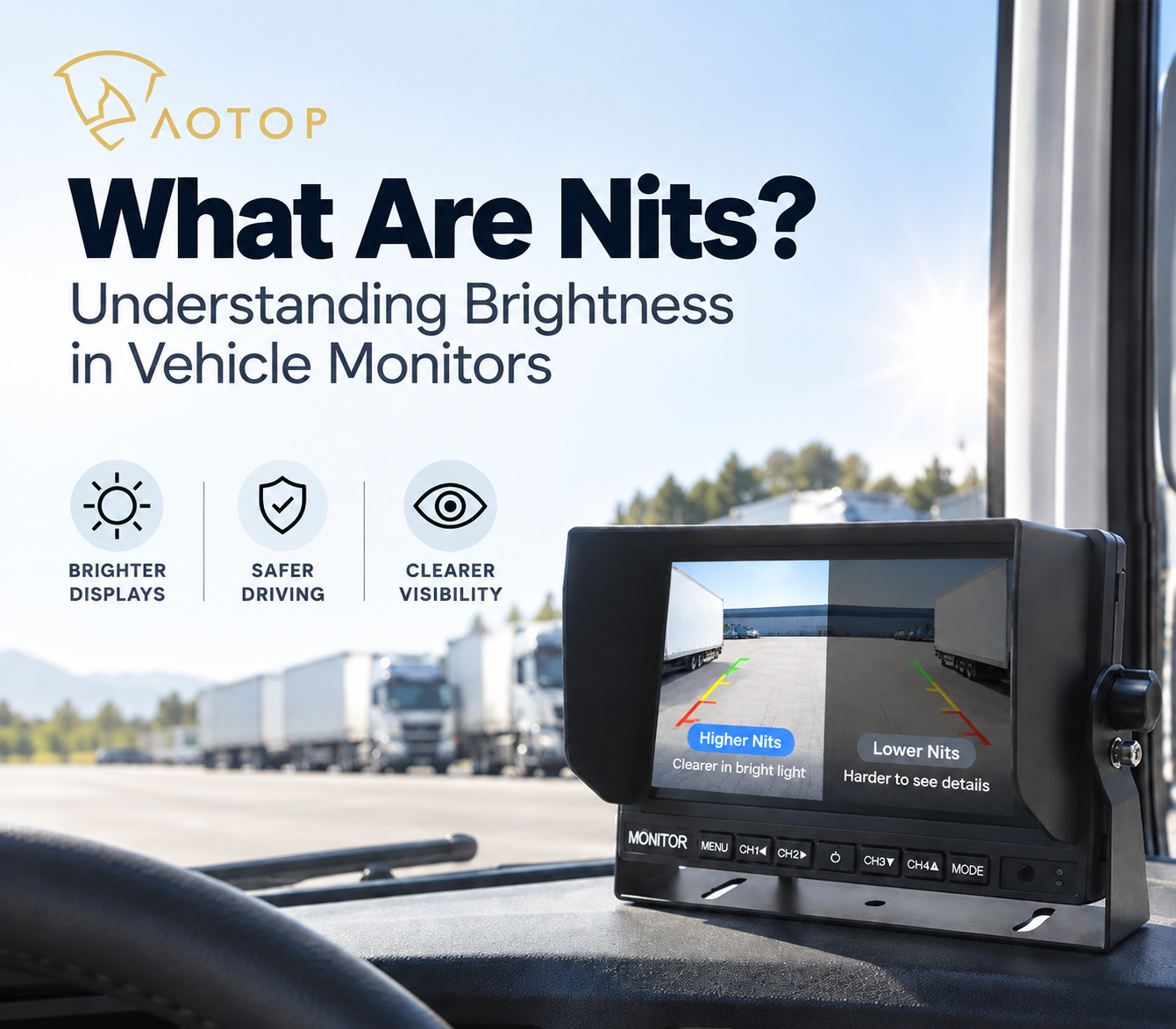
Product documentation should identify the accepted signal technologies and resolutions. For example, AOTOP’s 7-inch HD IPS vehicle monitor * lists AHD, 720p, 1080p, and CVBS compatibility.
For installations using vehicle DVR monitors, verify recording compatibility as well as live display. Multi-camera equipment may also impose channel-group restrictions or limits on mixed formats.
Conclusion
PAL and NTSC describe different image and timing characteristics in conventional CVBS systems. On AHD equipment, the same labels may indicate different frame rates at an identical resolution. The decisive question is whether the receiving device supports the camera’s exact signal technology, resolution, and timing. That distinction makes specifications easier to interpret and replacement-camera problems easier to diagnose.